
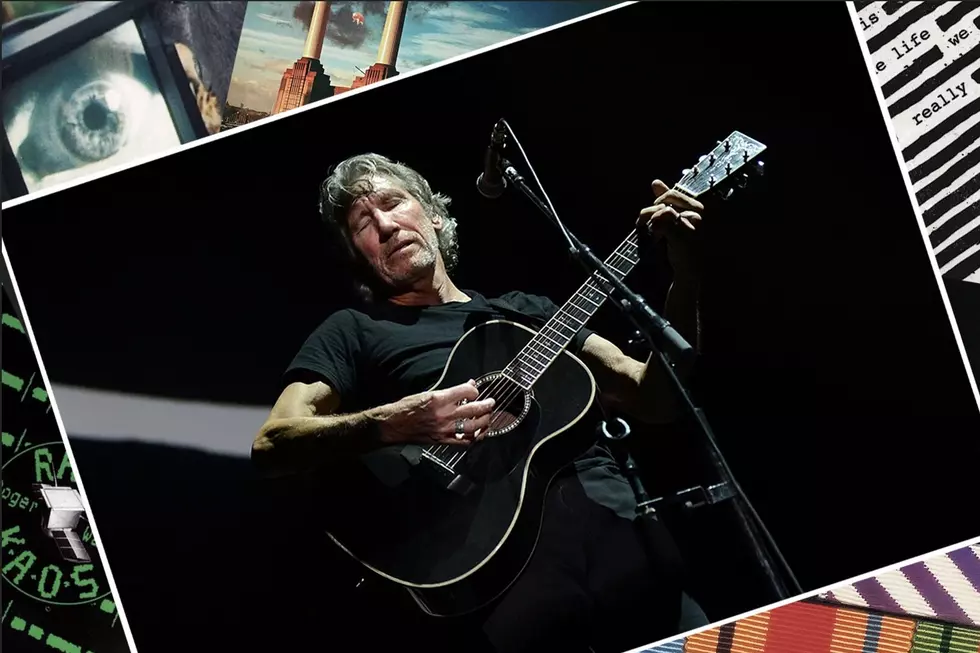
The 10 Political Songs That Redefined Roger Waters’ Career
Roger Waters wasn't always political. In fact, his first original songs with Pink Floyd tended more toward whimsy and wonder about the natural world around us. (He could also be deeply weird, to be sure.)
But something changed after his career-making '70s-era examinations of life, madness, death and the late Syd Barrett on 1973's Dark Side of the Moon and 1975's Wish You Were Here. Over the course of the three Pink Floyd albums that followed, Waters interrogated our shared history of conflict, pushed back against his own sorrow, and raged, raged, raged. If he avoided confrontations, there weren't many.
Before he left the group, 1977's Animals, 1979's The Wall and 1983's The Final Cut served as one round-house punch after another. Waters took on the power-mad, the compromised, the holier-than-thou, the war criminals, the rich. This set the stage for a solo career that kept a finger firmly pressed on hot-topic buttons.

What's Roger Waters' Best Political Song?
Waters was not nearly as prolific on his own, releasing just four original rock albums into the '10s. But he often made room for spiky commentary about issues of the day, particularly on 1987's Radio K.A.O.S. and 2017's long-awaited Is This the Life We Really Want?
READ MORE: Ranking Every Pink Floyd Album
In fact, he stayed determinedly contentious even when others began to shy away from political statements in this deeply divided new age. Some critics said he went too far. Waters' full-throated support of Palestinians, for instance, has led to repeated accusations of anti-Semitism.
Love him or hate him, he remained steadfast. As illustrated by the following list of Top 10 Roger Waters Political Songs, he never stopped asking hard questions and calling the powerful to account.
No. 10. "Two Suns in the Sunset"
From: The Final Cut (1983)
Topic: Nuclear proliferation
Waters ended The Final Cut with a mushroom cloud. This was originally envisioned as a soundtrack to the motion picture component for Pink Floyd's multimedia presentation of The Wall but then England declared war in the early-'80s after Argentina invaded one of its territories. The Final Cut became a stand-alone album driven by Waters' deep anti-war sentiment, which traced back to his father's death in World War II.
As with every post-Hiroshima conflict, the nagging worry back then was that an escalation in the Falklands War could lead to the use of nuclear weapons. Waters made that nightmare real: "The sun is in the east," he sings, "even though the day is done." We now know this 10-week conflict ended peacefully, but that was more than could be said for Pink Floyd after The Final Cut. Waters promptly went solo.
No. 9. "Watching TV"
From: Amused to Death (1992)
Topic: Totalitarianism
Perhaps Waters' best take on the conflict within organized religion (and that's saying something) was found on Amused to Death with "What God Wants, Pt. 1." But it's not like that broke any new narrative ground. Instead, this album's most underrated song finds Waters in a duet with Eagles' Don Henley on "Watching TV," perhaps the most boldly beautiful thing he's ever done.
Waters' sound opened up on Amused to Death. With the help of guitarist Jeff Beck and conductor Michael Kamen, the music once again matched his vocal intensity. As such, "Watching TV" might seem like a respite from the usual polemics, but a political current runs beneath the surface of this meditation on the 1989 Chinese youth movement against Communism.
No. 8. "Smell the Roses"
From: Is This The Life We Really Want? (2017)
Topic: Terrorism
Waters returned during a time of political turmoil almost a quarter century after 1992's Amused to Death. No surprise then that this album is among his most confrontational. "Smell the Roses" confronts the biggest fear of the age – and its biggest conundrum: "There's a mad dog pulling at his chain, a hint of danger in his eye," Waters offers at one point. "Close your eyes and pray this wind don't change."
In a surprising turn of events, however, Is This The Life We Really Want? was also Waters' most musically sentimental LP: "Smell the Roses" unleashes a tough guitar sound that recalls Pink Floyd's "Pigs (Three Different Ones)," found later on our list of Top 10 Roger Waters Political Songs. This tended to give new heft to even his most familiar grievances.
No. 7. "The Bravery of Being Out of Range"
From: Amused to Death (1992)
Topic: Warmongers, Lying Politicians
Boasting a thumping groove and this nasty guitar riff from Jeff Beck, "The Bravery of Being Out of Range" was a cutting (and quite prescient) condemnation of those who act as puppeteers for conflict while safely away from the front lines. In the years since, a modern-day trend toward remote-control warfare has only proliferated thanks to the ready availability and lower cost of drones.
Waters returned to this Amused to Death track (and "Two Suns in the Sunset") for 2020's stripped-down Lockdown Sessions. Discussing his new take on "The Bravery of Being Out of Range" in the liner notes, Waters could still summon sharp anger about U.S. combat operations from decades before.
No. 6. "The Powers That Be"
From: Radio K.A.O.S. (1987)
Topic: Bureaucrats, Jingoists
Commercial flourishes like sequenced drums and programmed keyboards all but sink "The Powers That Be" on first listen. "We tried too hard to make it sound modern," Waters admitted in Pigs Might Fly: The Inside Story of Pink Floyd. "I allowed myself to get pushed down roads that were uncomfortable for me."
Sort through those aural missteps, however, and you'll find a smart update of Waters' patented call to resist bloated bureaucracy and avowed militarists – "they like fear and loathing; they like sheep's clothing" — amid a shockingly funky horn signature.

No. 5. "Southampton Dock"
From: The Final Cut (1983)
Topic: Broken Promises
Waters constructed "Southampton Dock" around a leftover snippet from The Wall called "It's Never Too Late" – but this emotional, incredibly detailed narrative would have its own unique resonance. Family and neighbors had returned to England's Southampton Dock in the early-'80s to see soldiers off to the Falkland War, just as they had to fight the Germans in World War II. It was a striking image to build a song around.
As Waters laments elsewhere on The Final Cut, those resigned waves of goodbye signaled the end of the post-war dream of lasting peace. The War to End All Wars had done nothing of the sort. Neither did the next one. Still, David Gilmour pushed back against the politicization of their music – and against reusing older material. "Southampton Dock" would only feature Waters, with additional piano and orchestration from Michael Kamen.
No. 4. "Home"
From: Radio K.A.O.S. (1987)
Topic: Passive Citizenship, Racism
This song's farsighted message still rings true, despite being part of a synth-laden bid for MTV acceptance. (You should also ignore the album-length narrative that even Waters seemed to acknowledge was ridiculously overcomplicated by bundling Radio K.A.O.S. with an explanatory libretto.) Taken apart from that, "Home" challenges listeners to resist creeping indignities that eventually coalesce into true injustice.
Waters eventually hits on a lyrical riff, highlighting any number of unexpected personalities who might one day provide the greatest danger to our everyday lives: "Could be a lover, could be a fighter; could be a super heavyweight, or it could be something lighter." Along the way, he neatly presupposes the sweeping fear that gripped the U.S. in the wake of 9/11.
No. 2. "Pigs (Three Different Ones)"
From: Animals (1977)
Topic: Big Government, Corrupt Businessmen
Pink Floyd reached a career crossroads with "Pigs (Three Different Ones)," the most political song on a truth-to-power-themed album driven by Waters' quickly awakening muse. He'd become an increasingly sharp-edged public figure after Animals. By the '10s, some fans had begun to boo during solo performances of "Pigs," which now included vulgar sloganeering and portraits of the U.S. President.
Waters said he was taken aback. "I find it slightly surprising that anybody could have been listening to my songs for 50 years without understanding," he mused in a contemporary CNN interview. For those who didn't like it? Waters suggested should "go see Katy Perry or watch the Kardashians. I don't care."
No. 1. "Picture That"
From: Is This the Life We Really Want? (2017)
Topic: Lack of Political Leadership, Greed
After years of silence, Waters clearly felt compelled to return. "This is a runaway train in my view," he argued with Rolling Stone. "There could be nuclear war, easily, and nobody gives a s---. 'Well, so what?'" Those worries coalesced inside "Picture That." It was vintage vitriol for a new age, with a reliably seething lyric: "Picture a s---house with no f---ing drains; picture a leader with no f---ing brains."
Waters also showed a surprising willingness to look back. He'd already given "Deja Vu" a Wall-esque orchestral sweep. "Smell the Roses" slashed like "Pigs." "Picture That" continued to paint a caustic portrait of a world teetering on collapse – but this time, amid a metallic grind straight out of "Welcome to the Machine."
Pink Floyd Album Art: The Stories Behind 19 Trippy LP Covers
Gallery Credit: Nick DeRiso
Listen to David Gilmour on the 'UCR Podcast'